The complete NYC playbook
DOOH Media Strategies New York
New York is not one market — it's 73 distinct audiences stacked on top of each other. This page is the home for every DOOH play we run in NYC: real inventory, real screen counts, real dayparts, and a dedicated pitch page behind every card.
56,699
Live NYC screens
73
Strategies
4
Boroughs covered
Proposal pricing
Flat sample CPM
What "New York DOOH" actually looks like
Two moments only New York can deliver
Every strategy in this playbook lives inside a specific New York moment. These are two of ours — captured on the ground, not stock, not AI.
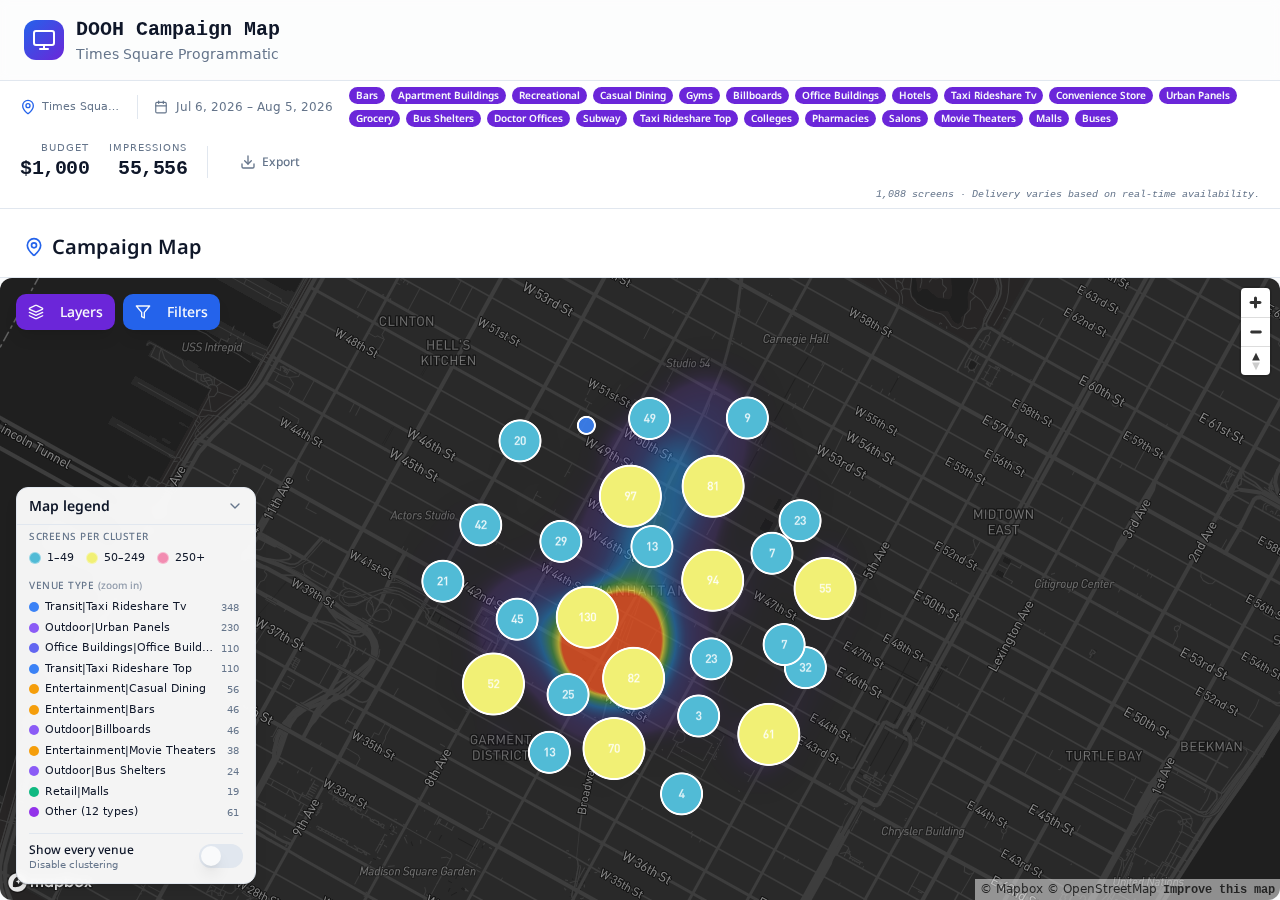
Times Square · Manhattan
The most-watched intersection in the world
Live programmatic screen map for the Times Square play — 1,088 screens in the Bowtie corridor. See the full plan in Times Square programmatic takeovers and more street-level angles in Iconic Screens.
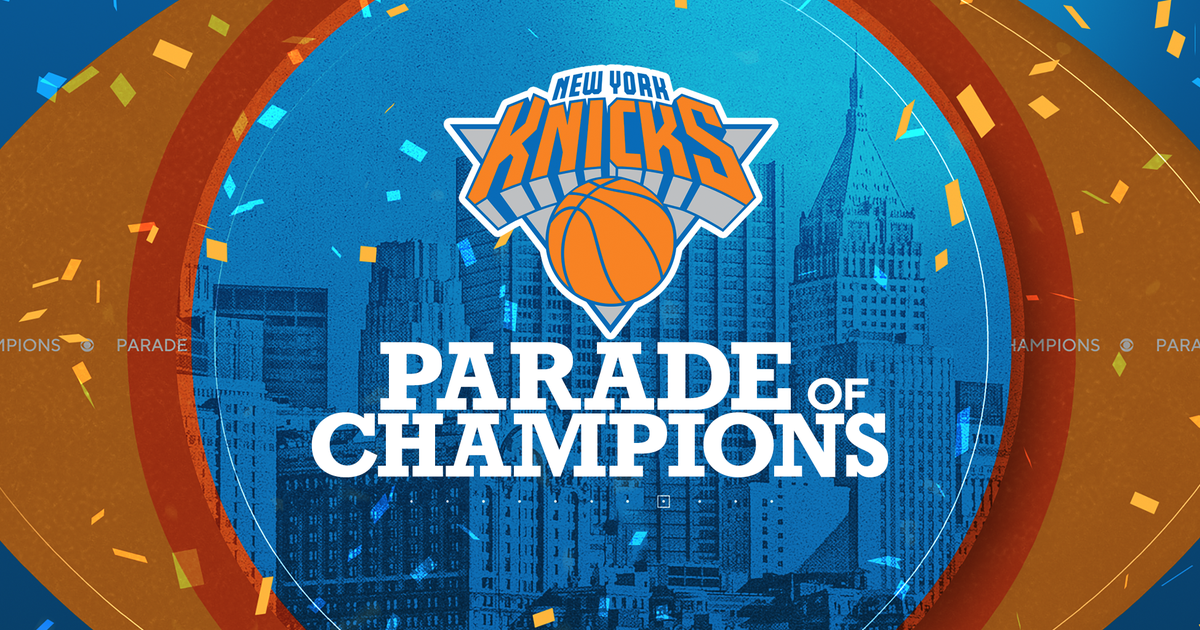
Canyon of Heroes · Lower Manhattan
Parade-of-Champions egress — every DOOH screen on the route
The image we built our Knicks Parade of Champions route map against — a live example of a same-day NYC moment plan.
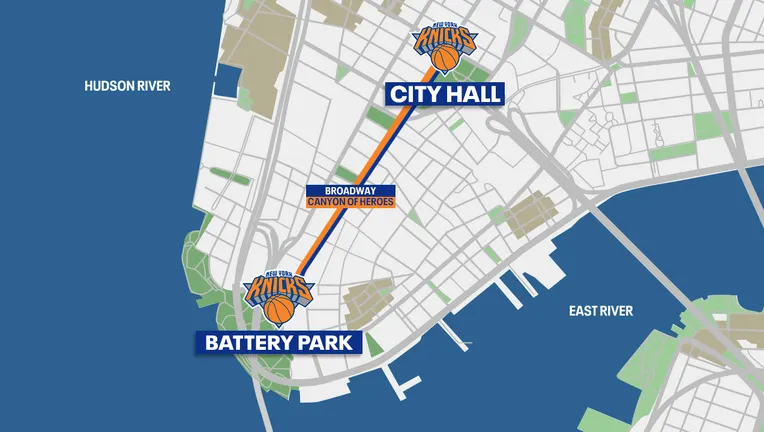
Working artifact · not a mock-up
A real DOOH route map, drawn on real inventory
Every play on this hub is built the same way as this map: pull the live Goldfish Ads inventory for the block, overlay the moment, pick the anchor screens. No made-up counts, no filler pins.
Why New York rewards specificity
One city, five boroughs, thirty entirely different audiences
#1 Nielsen DMA
New York is the largest Designated Market Area in the United States by Nielsen count — which is precisely why buying it as one blob wastes budget. This playbook breaks it into the thirty specific plays that actually convert.
Five boroughs, one plan
Manhattan, Brooklyn, Queens, the Bronx, and Staten Island each have their own daypart rhythm. The borough index above jumps you straight to the plays that live in the borough your brand actually needs.
Every count is a real count
Every screen number on every card comes from a saved Goldfish Ads campaign we built for that specific play — not category averages, not modelled estimates. If a page says 388 screens, that's what's live today.
How to use this page
Pick by audience, borough, or moment
Every card below links to a dedicated pitch page with a live inventory map, verified screen count, recommended venue types, dayparts, anchor locations, and FAQs — powered by the Goldfish Ads live inventory API.
Sample plans, maps, and proposals across these strategies are always reconciled using the publisher floor price plus a 15% Goldfish platform fee on the media CPM so budget-to-impression math is consistent across every borough and daypart.
Not sure where to start? Use the sticky index directly below to jump by borough or by first letter, or scroll to the category that matches your brand: B2B, sports, tourist, transit, luxury retail, or nightlife.
Borough coverage
Where the 73 plays live
Business & B2B
Reach the people who sign the checks
18 strategies · 12,602 screens
Enterprise buyers, founders, and industry press cluster in a small handful of NYC blocks — Javits, Wall Street, Silicon Alley, Hudson Yards, and Times Square. These plays intercept them mid-decision with synchronized digital urban panels, LinkNYC, and lobby-adjacent screens.
Hudson Yards / Hell's Kitchen · Manhattan
Javits Center
Turn the Javits Center's 2 million+ annual expo attendees into a captive B2B audience the moment they step outside — with street-level kiosks, digital urban panels, and 7-train egress screens synchronized to your show dates.
Audience · The people who sign the checks — mid-conference, mid-decision
Dayparts · 7:00–9:30 AM (morning arrivals) · 12:00–1:30 PM (lunch break egress) · 4:30–6:30 PM (day-end departure)
Venue types · Digital urban panels, Street-level kiosks, Digital bulletins
Financial District · Manhattan
Wall Street / FiDi
300,000+ finance professionals pour into a 12-block area every weekday morning. A tightly-dayparted DOOH buy on the NYSE / Oculus / Fulton Center screens puts your brand in front of them at the exact moment they're most alert and most reachable.
Audience · Institutional capital, on foot, before market open
Dayparts · 6:30–9:30 AM (pre-open commute) · 11:45 AM–1:15 PM (lunch) · 4:30–6:30 PM (post-close egress)
Venue types · Digital urban panels, Street-level kiosks, Transit / subway digital
Flatiron, Chelsea, Union Square · Manhattan
Silicon Alley
Silicon Alley concentrates NYC's tech workforce into a 14-block corridor between Union Square and Herald Square. Digital bus shelters, newsstands, and street-level kiosks along 5th and 6th Avenues catch them at coffee, lunch, and standup breaks.
Audience · Engineers, founders, and VCs — 40k tech workers per zip code
Dayparts · 8:30–10:00 AM (morning coffee) · 12:00–2:00 PM (lunch) · 5:30–7:00 PM (evening standup + happy hour)
Venue types · Digital urban panels, Street-level kiosks, Digital newsstands
Midtown Manhattan · Manhattan
Midtown Lunch Hour
Two hours a day, Midtown Manhattan becomes a walking city of C-suite and VP+ professionals. A dayparted DOOH buy across Bryant Park, Grand Central, and Rockefeller Center serves them 4-7 impressions per lunch — on foot, phone-down, receptive.
Audience · Fortune 500 execs, at street level, phones down
Dayparts · 11:30 AM–1:30 PM (executive lunch window) · 8:00–9:30 AM (morning arrival) · 5:30–7:00 PM (evening egress + dinner)
Venue types · Digital urban panels, Street-level kiosks, Digital bulletins
Hudson Yards · Manhattan
Hudson Yards
Hudson Yards is Manhattan's newest corporate campus and its most concentrated: BlackRock, KKR, Wells Fargo, Coach, L'Oréal, Meta, and 40+ other HQs share a single 28-acre footprint. DOOH here reaches an audience that's otherwise almost impossible to isolate.
Audience · 40+ HQs, one campus, one buy
Dayparts · 7:30–9:30 AM · 12:00–1:30 PM · 5:00–7:00 PM · Weekend 12:00–8:00 PM (tourist + High Line)
Venue types · Digital spectaculars, Digital urban panels, Office lobby screens
Financial District / Battery Park City · Manhattan
WTC & Brookfield Place
The reopened World Trade Center campus and neighboring Brookfield Place form the densest post-2001 finance and law footprint in the city — home to Condé Nast, Uber, Spotify, McKinsey, Goldman Sachs administrative offices, American Express, Bank of New York Mellon and dozens of AmLaw 100 firms. Their shared indoor concourses are DOOH gold.
Audience · Institutional finance, BigLaw and fintech buyers on a captive walk-in path
Dayparts · 7:30–9:30 AM (arrival) · 11:45 AM–1:30 PM (lunch on the Oculus & Winter Garden) · 5:00–7:00 PM (departure)
Venue types · Office lobby / elevator screens, Shopping mall digital, Digital urban panels
Chelsea / Hudson Yards South · Manhattan
Pier 57 & West Side Tech
Pier 57 hosts Google's NYC campus expansion, City Winery, the Market 57 food hall by James Beard, and Little Island's foot-traffic engine — with Chelsea Market, 111 Eighth Ave (Google) and the Meatpacking tech corridor all a two-block walk away. This is the densest concentration of software engineers in New York.
Audience · Software engineers, PMs, data scientists and venture-backed founders
Dayparts · 8:30–10:00 AM (arrival) · 12:00–1:45 PM (lunch) · 5:30–7:30 PM (departure)
Venue types · Digital urban panels, Digital bus shelters, Street-level kiosks
Roosevelt Island · Manhattan
Cornell Tech / Roosevelt Island
Cornell Tech's Roosevelt Island campus — home to the Bloomberg Center, Tata Innovation Center and The House — concentrates New York's applied-research and startup-founder audience into a one-mile island served by a tram and a single subway stop.
Audience · Deep-tech researchers, startup founders and clean-energy investors
Dayparts · 8:30–10:00 AM (class arrival) · 12:00–1:30 PM (lunch) · 5:00–7:00 PM (research departure)
Venue types · Transit / subway digital, Digital urban panels, Street-level kiosks
Midtown East / Park Avenue · Manhattan
Convene Corporate Summits
Convene runs New York's largest network of premium flex meeting venues — 237 Park Avenue, 101 Park Avenue, 117 W 46th, 730 Third Avenue, One Boston Place style spaces — hosting corporate summits, private board offsites and product launches every business day.
Audience · B2B event hosts, HR leaders and mid-to-senior corporate decision-makers
Dayparts · 7:30–9:30 AM (arrival) · 12:00–1:30 PM (event lunch) · 5:00–7:00 PM (departure & receptions)
Venue types · Office lobby / elevator screens, Digital urban panels, Street-level kiosks
Midtown West / Hell's Kitchen · Manhattan
Lavan Midtown Events
Lavan's West 42nd Street venues (Lavan 541, Lavan Chelsea) sit at the seam between Hudson Yards, Times Square and the Javits Center — the exact block where luxury launches, automotive reveals and PR-driven product moments cluster in New York.
Audience · Experiential marketers, luxury brand managers, automotive execs and tech PR
Dayparts · 10:00 AM–12:00 PM (setup / press arrival) · 1:00–3:00 PM (launch windows) · 6:00–10:00 PM (evening receptions)
Venue types · Digital bulletins, Taxi tops / rideshare digital, Street-level kiosks
Greenpoint · Brooklyn
Greenpoint Studios
Greenpoint is the working center of NYC-based commercial and streaming production. Broadway Stages alone runs 50+ soundstages across the neighborhood; Steiner, Kaufman Astoria's overflow work, and dozens of independent design and post-production studios cluster within a ten-minute walk of Franklin and Manhattan Ave.
Audience · Commercial directors, agency producers, indie designers and production crews
Dayparts · 7:30–9:30 AM (call-time coffee) · 12:30–2:30 PM (lunch break) · 6:30–8:30 PM (wrap egress)
Venue types · Digital urban panels, Digital bus shelters, Street-level kiosks
Wallabout / Brooklyn Navy Yard · Brooklyn
Brooklyn Navy Yard
The Brooklyn Navy Yard is a 300-acre, 550-tenant innovation campus — one of the largest concentrations of urban manufacturing, hardware startups, media production, and green-tech companies in the country. It's a secure campus, which makes the perimeter and lobby DOOH footprint disproportionately valuable for B2B advertisers.
Audience · Hardware tech founders, urban manufacturers, architects and maritime leaders
Dayparts · 8:00–10:00 AM (arrival) · 12:00–2:00 PM (lunch / food-court) · 5:00–7:00 PM (departure)
Venue types · Office lobby digital (Dock 72, Bldg 92), Digital urban panels, Digital bus shelters
Sunset Park · Brooklyn
Industry City
Industry City is a 6-million-square-foot, 16-building innovation campus on the Sunset Park waterfront. 8,500+ workers across 500+ tenant companies — ecommerce brands, design studios, food producers, and media tech — cycle through the same central courtyards, food halls, and retail spines every day.
Audience · Ecommerce founders, artisans, media-tech teams, and high-spending design consumers
Dayparts · 8:00–10:00 AM (arrival) · 12:00–2:00 PM (food-hall lunch) · 5:00–7:00 PM (departure) · Sat/Sun 11:00 AM–5:00 PM (visitor peak)
Venue types · Interior digital directories, Retail courtyard digital, Digital urban panels
Downtown Brooklyn / Cadman Plaza · Brooklyn
Downtown Brooklyn Courts
Downtown Brooklyn's Cadman Plaza / Court Street corridor is one of the densest concentrations of legal, municipal, and civic decision-makers in the country. Kings County Supreme Court, the Brooklyn Federal Courthouse, Brooklyn Borough Hall, and hundreds of law firms cluster within a three-block radius.
Audience · Attorneys, legal-tech buyers, civil servants and administrative decision-makers
Dayparts · 8:30–10:00 AM (court-call arrival) · 12:00–1:30 PM (lunch) · 4:00–5:30 PM (court-day dismissal)
Venue types · Digital urban panels, Transit entrance digital (subway), Street-level kiosks
Washington Heights / Fort Washington · Manhattan
Washington Heights Medical
The Columbia University Irving Medical Center / NewYork-Presbyterian campus in Washington Heights is one of the largest and highest-ranked academic medical centers in the world. The 20-block footprint along Fort Washington Avenue and Broadway concentrates physicians, researchers, and healthcare executives in a walkable ring.
Audience · Healthcare executives, physicians, research scientists and medical-equipment buyers
Dayparts · 6:30–9:00 AM (shift change + AM commute) · 12:00–1:30 PM (lunch) · 5:00–8:00 PM (shift change + PM commute)
Venue types · Digital urban panels, Digital bus shelters, Street-level kiosks
Kips Bay · Manhattan
Kips Bay Hospital Corridor
The 1st Avenue corridor between 23rd and 34th is one of the most concentrated hospital and medical-school footprints in the United States — NYU Langone (Tisch, Kimmel Pavilion), Bellevue, the VA NY Harbor Healthcare System, and the NYU Grossman School of Medicine anchor a walkable medical district.
Audience · Medical staff, lab technicians, healthcare administrators and public-health officials
Dayparts · 6:30–8:30 AM (AM shift change) · 12:00–1:30 PM (lunch) · 2:30–4:00 PM (mid-shift change) · 6:30–8:00 PM (PM shift change)
Venue types · Digital urban panels, Digital bus shelters, Street-level kiosks
Garment District · Manhattan
Garment District
The Garment District — 7th and 8th Avenues from 34th to 42nd — is still the operating heart of American fashion sourcing and manufacturing. Design studios, fabric jobbers, trim and notion houses, wholesale showrooms, and the FIT student body cluster in a ten-block grid unlike anywhere else in the country.
Audience · Apparel designers, textile buyers, fashion manufacturing execs and wholesale showroom managers
Dayparts · 8:30–10:00 AM (arrival) · 12:00–2:00 PM (lunch + showroom walk-throughs) · 5:00–7:00 PM (departure)
Venue types · Digital urban panels, Street-level kiosks, Digital bus shelters
Penn District / Midtown South · Manhattan
Penn District
Vornado's Penn District revitalization has turned the blocks around West 34th Street and 7th–8th Avenues into one of the newest premium office footprints in Manhattan. PENN 1 and PENN 2 now anchor tenants like Apple, Meta, Cisco, Samsung, Madison Square Garden Company, and Peloton — an ~11-million-square-foot tech-and-media campus adjacent to Penn Station's 650,000 daily commuters.
Audience · Big-tech office tenants, retail buyers and high-volume daily commuters
Dayparts · 7:30–10:00 AM (arrival + Penn commute) · 12:00–2:00 PM (lunch) · 5:00–7:30 PM (departure + Penn commute) · MSG event nights (event-time upweight)
Venue types · Plaza digital spectaculars, Digital urban panels, Street-level kiosks
Sports & Entertainment
Own the moment fans exit the venue
6 strategies · 3,228 screens
Game-day and show-night egress delivers a captive, emotional audience. We concentrate impressions on the 30-minute window after the final whistle around MSG, Barclays, Yankee Stadium, Citi Field, and Broadway — when creative recall is at its peak.
Penn Station / Midtown West · Manhattan
Madison Square Garden
20,000 fans exit Madison Square Garden in under 12 minutes after every Knicks game, Rangers game, and headline concert. A pre-triggered DOOH burst on 7th and 8th Avenues turns that egress into a captive, high-energy audience for QSR, sports betting, ride-share, and streaming.
Audience · High-arousal fans, one exit corridor, zero distractions
Dayparts · Event-triggered: T-15 min to T+30 min from scheduled event end · 6:00–7:30 PM pre-game · Late-night 10:00 PM–1:00 AM (post-event)
Venue types · Digital urban panels, Street-level kiosks, Digital bulletins
Prospect Heights / Atlantic Yards · Brooklyn
Barclays Center
The Atlantic Avenue-Barclays Center transit hub is Brooklyn's densest DOOH surface. Nine subway lines and the LIRR converge here, and every Nets, Islanders, and concert egress funnels through it. A geofenced DOOH burst reaches Brooklyn-native millennials at peak cultural energy.
Audience · Brooklyn-native, culturally-active, mobile-first
Dayparts · Event-triggered T-15 to T+45 min · Pre-event 5:30–7:30 PM · Weekend afternoon (mixed programming)
Venue types · Transit / subway digital, Street-level kiosks, Digital urban panels
Concourse / South Bronx · Bronx
Yankee Stadium
81 home games and dozens of concerts push 3M+ fans through a 4-block Bronx perimeter each year — most arriving by subway, many by car on the Major Deegan. Game-day DOOH here is the sharpest lever for sports betting, beer, QSR, and mass-consumer brands in the tri-state.
Audience · Yankees fans, Bronx-native and tri-state suburban, high-arousal
Dayparts · Game day T-3 hrs to T+90 min post-final-out · Weekend day games all-day · Playoff windows (October) — extended flighting
Venue types · Roadside digital bulletins, Transit / subway digital, Digital urban panels
Flushing Meadows – Corona Park · Queens
US Open / Citi Field
Two weeks a year, Flushing Meadows becomes the East Coast's densest concentration of tennis enthusiasts, high-income sports fans, and corporate hospitality guests. A synchronized Grand Central Parkway + Willets Point buy hits them on arrival, between sessions, and again on the way home.
Audience · Tennis fans, Mets crowds, and corporate hospitality — all in one geofence
Dayparts · US Open day session T-2 hrs → +90 min post · US Open night session T-2 hrs → +90 min post · Mets home-game T-2 hrs → +90 min post
Venue types · Roadside digital bulletins, Transit / subway digital, Digital urban panels
Marathon Route (BK 4th Ave + MN 1st Ave) · Manhattan
NYC Marathon
The TCS New York City Marathon is the world's largest marathon by finisher count. On the first Sunday of November, 55,000+ runners and 2 million spectators line the same 26.2-mile course — with 4th Avenue in Brooklyn and 1st Avenue in Manhattan as the two densest cheering zones.
Audience · Elite fitness consumers, running enthusiasts and sports-nutrition brand targets
Dayparts · 4th Ave Brooklyn: 9:30 AM–1:30 PM (race Sunday) · 1st Ave Manhattan: 11:30 AM–3:30 PM (race Sunday)
Venue types · Street-level kiosks, Digital urban panels, Digital bus shelters
Randall's Island / East Harlem / Astoria approaches · Manhattan
Governors Ball
Governors Ball is New York's flagship music festival — a three-day June event on Randall's Island that draws 150,000 Gen Z and Millennial attendees. Because Randall's Island is only reachable via a handful of pedestrian bridges and shuttle routes, the pre- and post-festival transit windows create predictable, captive DOOH targeting opportunities.
Audience · Gen Z and Millennial music fans, festival sponsors and youth-lifestyle buyers
Dayparts · Fri/Sat/Sun 11:00 AM–4:00 PM (festival ingress) · Fri/Sat/Sun 10:00 PM–1:00 AM (festival egress) · Thu 4:00–9:00 PM (build-up)
Venue types · Street-level kiosks, Digital bus shelters, Digital urban panels
Cultural & Tourist
High-dwell tourist and cultural audiences
8 strategies · 4,433 screens
Tourists dwell longer, walk more slowly, and photograph everything. Radio City, Rockefeller Center, the Meatpacking District, and Central Park's south edge deliver 20-second unaided attention windows that no mobile format can match.
Theater District / Times Square · Manhattan
Broadway Theater District
13 million Broadway tickets are sold every year, and nearly every ticket-holder walks the same 8-block grid between 5 and 7 PM on their way to dinner and the show. That's the most affluent, most attentive, most photograph-happy tourist audience in America — hiding in plain sight.
Audience · HNW tourists, empty-nesters, and celebration spenders
Dayparts · 5:00–7:00 PM (pre-show dinner) · 10:15–11:30 PM (post-show) · 12:30–2:30 PM (matinee pre-show)
Venue types · Digital urban panels, Street-level kiosks, Digital spectaculars
Rockefeller Center · Manhattan
Radio City Music Hall
Radio City queues stretch a full block along 6th Avenue for the Rockettes' Christmas Spectacular, Tribeca screenings, and A-list residencies. Slow-moving lines translate directly into exceptional DOOH dwell time — 4-8 minutes of face-time per impression.
Audience · High-dwell, family-heavy, receptive-to-story
Dayparts · Show-triggered T-45 min to T-0 · Weekend matinee pre-queue · Holiday season all-day (Nov-Jan)
Venue types · Digital urban panels, Street-level kiosks, Digital bulletins
Battery Maritime Building / Governors Island · Manhattan
Governors Island Ferry
Governors Island — the 172-acre former Coast Guard base managed by the Trust for Governors Island — has become New York's fastest-growing weekend leisure destination, anchored by the QC NY spa, seasonal food halls, art programming and the ferry line that queues down the Battery Maritime Building.
Audience · Affluent wellness consumers and design-conscious weekend leisure travelers
Dayparts · Saturday–Sunday 9:30 AM–2:00 PM (peak departure) · Friday 4:00–8:00 PM (weekend arrivals) · Sunday 5:00–8:00 PM (return traffic)
Venue types · Digital urban panels, Street-level kiosks, Ferry terminal digital
Belmont / Arthur Avenue · Bronx
Arthur Avenue Bronx
Arthur Avenue and the surrounding Belmont neighborhood — often described as the real Little Italy of New York — draws a weekend regional food and cultural audience that indexes above median on gourmet, hospitality and premium consumer categories.
Audience · Gourmet culinary shoppers, regional tourists and upscale food influencers
Dayparts · Saturday–Sunday 11:00 AM–4:00 PM (peak weekend dining) · Weekday 11:30 AM–1:30 PM (lunch) · Weekday 5:00–7:30 PM (Fordham post-class)
Venue types · Digital urban panels, Street-level kiosks, Bus shelter digital
Tribeca · Manhattan
Tribeca Festival
For roughly ten days each June, Tribeca becomes the walkable center of gravity for the film industry — festival passes, premiere lines, and industry after-parties concentrate the kind of audience LinkedIn charges $30 CPC to reach into a six-block radius around Spring, Greenwich, and Varick.
Audience · Film executives, creative directors, celebrities and affluent downtown residents
Dayparts · 11:00 AM–1:00 PM (matinee queues) · 5:30–7:30 PM (industry-block ingress) · 9:30–11:30 PM (post-screening Q&A + reception egress)
Venue types · Street-level kiosks, Digital bus shelters, Urban panels
Lincoln Square · Manhattan
Lincoln Center
Lincoln Center is the country's largest performing-arts complex — the Met Opera, NY Philharmonic, NYC Ballet, Jazz at Lincoln Center, and the Chamber Music Society all share one 16.3-acre plaza. Every performance evening, a wealthy, appointment-driven audience walks the same three-block radius twice.
Audience · Affluent culture patrons, corporate donors, and luxury-brand household decision-makers
Dayparts · 6:30–8:00 PM (pre-curtain) · 8:45–9:30 PM (intermission) · 10:15–11:15 PM (post-curtain reception) · Sat/Sun 12:30–2:00 PM (matinee)
Venue types · Digital bus shelters, Urban panels, Street-level kiosks
Tribeca / Chelsea (Fashion Week Venues) · Manhattan
NYFW
For roughly eight days in February and September, New York Fashion Week concentrates the global luxury and fashion industry into a handful of venues — Spring Studios in Tribeca, the West Side piers, and the rotating unofficial show spaces around Meatpacking and Chelsea. The audience is unrivaled for luxury reach density.
Audience · Global fashion buyers, luxury influencers, beauty executives and international media
Dayparts · Feb + Sep NYFW windows: 30-min pre-show / intermission / 45-min post-show egress · Off-cycle: 6:30–8:30 PM Tribeca / Chelsea evening flow
Venue types · Digital urban panels, Street-level kiosks, Digital bus shelters
Rockefeller Center · Manhattan
Rockefeller Center Holiday
From the tree lighting the Wednesday after Thanksgiving through early January, the block bounded by 5th–6th and 49th–50th becomes the most photographed sidewalk in the world. Tourist volume around the Rockefeller Center tree, the rink, and Saks Fifth Ave regularly overwhelms the surrounding pedestrian network.
Audience · Seasonal tourist waves, CPG consumers and holiday entertainment buyers
Dayparts · 11:00 AM–8:00 PM (peak tourist volume) · Fri/Sat 11:00 AM–11:00 PM (extended evening) · Nov Wed tree-lighting window (all-day)
Venue types · Digital urban panels, Street-level kiosks, Digital bus shelters
Transit & Commuter Hubs
Intercept the daily commute at scale
17 strategies · 13,851 screens
Penn Station, Grand Central, Port Authority, and the LIRR/NJ Transit corridors move over 2M commuters daily through predictable choke points. These plays convert wait time into ~15-second dwell impressions with no scroll competition.
Midtown West / Herald Square · Manhattan
Penn Station Commuters
Penn Station moves more than 600,000 daily commuters — the largest transit hub in North America. Digital screens inside the entrance corridors and adjacent 34th Street urban panels catch a captive suburban audience twice a day, five days a week.
Audience · Long Island and New Jersey suburban commuters, high-frequency
Dayparts · 6:30–9:30 AM (AM peak) · 11:45 AM–1:15 PM (lunch) · 4:30–7:30 PM (PM peak)
Venue types · Transit / subway digital, Digital urban panels, Street-level kiosks
Midtown East · Manhattan
Grand Central Terminal
Grand Central is where Westchester and Fairfield County meet Midtown. A concentric buy across the 42nd / Lexington / Park Avenue perimeter puts wealth managers, luxury brands, and premium consumer categories in front of the exact HHI they want to reach.
Audience · Affluent suburban commuters — wealth management's dream ZIP codes
Dayparts · 7:00–9:30 AM (AM peak) · 11:45 AM–1:30 PM (lunch) · 5:00–7:30 PM (PM peak)
Venue types · Digital urban panels, Transit / subway digital, Office lobby screens
Jamaica / Van Wyck Corridor · Queens
JFK Airport Arrivals
JFK handles 60M+ passengers a year. The Van Wyck Expressway and airport exit loops funnel every rideshare, taxi, and shuttle out of the terminals past a small set of high-impact digital roadside boards — the first ad every international arrival sees on U.S. soil.
Audience · International arrivals, business travelers, and affluent tourists
Dayparts · 24/7 with lift on international arrival banks (6-10 AM, 4-8 PM) · Weekend evening tourist arrivals
Venue types · Roadside digital bulletins, Airport & rideshare pickup, Gas stations & c-stores
East Elmhurst · Queens
LaGuardia Airport
LaGuardia is the East Coast's default domestic business-travel airport. A tight geofence around the terminal ground-transportation zones and the Grand Central Parkway approach delivers frequent-flyer reach at expensed-hotel intent moments.
Audience · Frequent flyers, consultants, and domestic business travelers
Dayparts · Weekday AM arrivals 6:30–10:30 AM · Weekday PM arrivals 4:30–8:30 PM · Sunday evening arrivals (weekly business kickoff)
Venue types · Airport & rideshare pickup, Roadside digital bulletins, Digital urban panels
Midtown West / Hell's Kitchen · Manhattan
Port Authority Bus Terminal
The Port Authority Bus Terminal is North America's busiest bus terminal — 200k+ daily commuters funneling through a single 8th Avenue / 42nd Street footprint. Digital spectaculars and street furniture at this intersection deliver frequency at scale that few DOOH buys match.
Audience · New Jersey commuters, retail workers, and Times Square-adjacent foot traffic
Dayparts · 5:30–9:30 AM (AM peak) · 12:00–1:30 PM (lunch) · 4:00–8:00 PM (PM peak)
Venue types · Digital urban panels, Street-level kiosks, Transit / subway digital
Whitehall & St. George · Manhattan
Staten Island Ferry
The Staten Island Ferry moves 65,000 daily riders across two terminals for free. That means high-dwell wait times, phones-up but eyes-forward, and one of the most captive audience conditions in New York City DOOH.
Audience · Daily municipal workers, tourists, and Staten Island commuters
Dayparts · 7:00–9:30 AM (AM commute) · 5:00–7:30 PM (PM commute) · Weekend 10 AM–6 PM (tourist)
Venue types · Digital urban panels, Street-level kiosks, Transit / subway digital
Midtown West / Hudson Yards · Manhattan
Moynihan Train Hall
Moynihan Train Hall — the $1.6 billion James A. Farley Building conversion opened January 2021 — is Amtrak's flagship New York terminal and the main westside LIRR concourse. Its 92-foot skylit hall is one of the most premium indoor DOOH environments in the country.
Audience · Northeast Corridor Acela business travelers and premium LIRR commuters
Dayparts · 7:30–10:00 AM (Acela + LIRR peak) · 12:00–1:30 PM (lunch walk) · 5:00–7:30 PM (departure)
Venue types · Transit / subway digital, Digital urban panels, Street-level kiosks
Financial District / World Trade Center · Manhattan
Oculus PATH Commuters
The Santiago Calatrava-designed World Trade Center Transportation Hub — the Oculus — is the ground-floor arrival gate for PATH commuters from Jersey City, Hoboken and Newark. It moves upwards of 250,000 people per weekday into Lower Manhattan.
Audience · Jersey City, Hoboken and Newark tech, finance and creative professionals
Dayparts · 7:30–9:30 AM (PATH arrival peak) · 12:00–1:30 PM (lunch) · 5:00–7:00 PM (departure)
Venue types · Transit / subway digital, Shopping mall digital, Street-level kiosks
Jamaica · Queens
Jamaica Station JFK AirTrain
Jamaica Station is the largest LIRR station outside Penn and the only rail-to-JFK-AirTrain interchange — the audience is a mix of international business travelers, airline crew, JFK-area hospitality staff and transit-reliant Queens commuters.
Audience · International business travelers and JFK airport-adjacent workforce
Dayparts · 5:00–8:00 AM (early flights + AM peak) · 11:00 AM–2:00 PM (business travel bank) · 4:00–8:00 PM (evening flights + PM peak)
Venue types · Transit / subway digital, Airport DOOH (AirTrain adjacent), Street-level kiosks
Crown Heights / Prospect Heights / Bed-Stuy · Brooklyn
Atlantic Avenue Brooklyn
Atlantic Avenue is the geographic and commercial spine of central Brooklyn — anchored by the Barclays Center / Atlantic Terminal transit hub and cutting through Boerum Hill, Prospect Heights, Crown Heights and Bedford-Stuyvesant. It is Brooklyn's most legible cross-borough audience corridor.
Audience · Urban professionals, design-conscious consumers and young families
Dayparts · 7:00–9:30 AM (AM peak) · 12:00–2:00 PM (lunch retail) · 5:00–8:00 PM (PM peak + evening dining)
Venue types · Digital urban panels, Digital bus shelters, Street-level kiosks
Washington Heights · Manhattan
GWB Bus Terminal
The Port Authority-operated George Washington Bridge Bus Terminal (Fort Washington & 178th) is Upper Manhattan's regional gateway — feeding NJ Transit and private carrier buses from Bergen County into the A-train system and directly into the Columbia University Irving Medical Center / New York-Presbyterian corridor.
Audience · Bergen County commuters, uptown medical staff and Washington Heights residents
Dayparts · 6:00–9:30 AM (NJ Transit AM peak + hospital shift start) · 2:00–4:00 PM (hospital shift change) · 5:00–8:00 PM (PM peak)
Venue types · Transit / subway digital, Digital urban panels, Street-level kiosks
Long Island City / Hunters Point · Queens
Long Island City Waterfront
Long Island City's Hunters Point and Court Square waterfront has become New York's fastest-growing residential + tech workforce corridor — home to Amazon's Fresh HQ operations, JetBlue, MOMA PS1, and a dense cluster of luxury waterfront towers with a direct 7 / E / M / G / N / W subway pipeline into Manhattan.
Audience · Tech professionals and young dual-income couples commuting to Manhattan
Dayparts · 7:00–9:30 AM (AM peak) · 12:00–1:30 PM (lunch) · 5:30–8:00 PM (PM peak + evening dining)
Venue types · Transit / subway digital, Digital urban panels, Street-level kiosks
Midtown East / Upper East Side · Manhattan
Hamptons Jitney
Every Thursday afternoon and Friday morning from Memorial Day through Labor Day, the sidewalks at 40th & Lexington and 86th & 3rd fill with the wealthiest weekend commute in America. The Hampton Jitney and Luxury Liner queues turn two ordinary Midtown corners into a captive HNW audience with predictable dwell time.
Audience · High-earning executives and dual-income households escaping to the East End
Dayparts · Thursday 3:00–7:00 PM (peak eastbound) · Friday 7:00 AM–12:00 PM (morning eastbound) · Sunday 4:00–9:00 PM (westbound return)
Venue types · Digital bus shelters, Digital urban panels, Street-level kiosks
East Side Manhattan (FDR Corridor) · Manhattan
FDR Drive
The FDR Drive is the most reliably congested six lanes in New York. Weekday AM and PM peaks routinely see stop-and-go for miles between the Battery and 96th Street — turning a commute into a captive dwell window on the digital spectaculars along the east side of Manhattan.
Audience · C-suite commuters and daily B2B drivers between Westchester, Upper Manhattan and Downtown
Dayparts · 7:00–10:00 AM (AM peak) · 4:00–7:30 PM (PM peak) · Real-time trigger: <15 mph segment speed
Venue types · Digital billboards, Digital spectaculars, Digital urban panels
West Side Manhattan (Route 9A) · Manhattan
West Side Highway
Route 9A / West Side Highway is the primary north-south commuter artery on the west side of Manhattan. Between the George Washington Bridge and Battery Park, it feeds every major corporate corridor — Hudson Yards, Chelsea Piers, Tribeca, and the Financial District — and moves the fleet, black-car, and executive-driver audience past the same spectaculars twice a day.
Audience · NJ and suburban executives, corporate fleet managers, and luxury-car buyers
Dayparts · 7:00–10:00 AM (AM peak northbound) · 4:00–8:00 PM (PM peak southbound) · Sat 9:00 AM–1:00 PM (weekend outbound)
Venue types · Digital billboards, Digital spectaculars, Urban panels
Hell's Kitchen / Lincoln Tunnel Approach · Manhattan
Lincoln Tunnel
The Lincoln Tunnel Manhattan approach is one of the most congested captive audiences in the country. The Port Authority Bus Terminal handles 8,000+ bus movements per day and the tunnel itself moves 100,000+ vehicles daily — creating multi-mile backlogs on the 9th and 10th Avenue approaches where every driver and passenger has 10–20 minutes of screen-time.
Audience · Captive NJ commuters, corporate workforce professionals, and mobile-app consumers
Dayparts · 7:00–10:00 AM (AM peak inbound) · 3:30–7:30 PM (PM peak outbound) · Fri 2:30–8:00 PM (extended outbound)
Venue types · Digital spectaculars, Digital urban panels, Street-level kiosks
Long Island City / Hunters Point · Queens
Queensboro/Midtown Tunnel
The Queensboro Bridge and Queens-Midtown Tunnel move over 200,000 vehicles a day between Queens and Manhattan. Their Queens-side approach plazas — Northern Boulevard, Queens Plaza, and the Long Island City feeder streets — become predictable congestion zones with prime dwell time for digital screens.
Audience · Long Island and Queens business owners, construction executives, and corporate commuters
Dayparts · 6:30–10:00 AM (AM peak westbound) · 4:00–7:30 PM (PM peak eastbound) · Sat 8:00 AM–12:00 PM (weekend outbound)
Venue types · Digital spectaculars, Digital billboards, Urban panels
Luxury, Retail & Shopping
Premium retail corridors with high-HHI dwell
11 strategies · 16,099 screens
Fifth Avenue, Madison, SoHo, and Hudson Yards concentrate the top 5% of household income into walkable retail corridors. Digital storefront panels and luxury-mall directories reach shoppers seconds before they enter a competing store.
Midtown / Plaza District · Manhattan
Fifth Avenue Luxury
The 10-block stretch of Fifth Avenue between 49th and 59th is the highest-rent retail corridor on Earth. A premium DOOH buy on adjacent street-level displays puts your brand next to Louis Vuitton, Tiffany, Bergdorf, and Apple's cube — visible to the exact HHI you want.
Audience · High-net-worth shoppers, international luxury buyers, and fashion influencers
Dayparts · 10:00 AM–8:00 PM shopping hours · Q4 holiday heavy-up (Oct 15–Dec 31) · Fashion Week windows (Feb, Sept)
Venue types · Digital urban panels, Street-level kiosks, Hotel lobby screens
SoHo · Manhattan
SoHo Fashion Shopping
SoHo's cobblestone streets slow foot traffic to a browse pace. Digital urban panels on Broadway, Prince, and Spring capture Gen Z and Millennial shoppers with dwell times that dwarf Midtown — perfect for fashion, beauty, and DTC brand launches.
Audience · Trend-conscious Gen Z and Millennial shoppers, creatives, and retail tourists
Dayparts · Fri–Sun 12:00 PM–7:00 PM (shopping peak) · Weekday 11 AM–7 PM (tourist evergreen) · Fashion Week + product-launch heavy-ups
Venue types · Digital urban panels, Street-level kiosks, Coffee shop screens
Williamsburg · Brooklyn
Williamsburg Waterfront
Williamsburg's Saturday and Sunday leisure economy is a distinct DOOH audience — affluent hip creatives, young families, and weekend travelers browsing Bedford Avenue and the North 5th ferry landing at a pace Manhattan can't match.
Audience · Affluent creatives, young families, and trend-forward weekend visitors
Dayparts · Sat–Sun 11:00 AM–7:00 PM (weekend leisure peak) · Thu–Fri 5:00 PM–9:00 PM (dinner + evening)
Venue types · Digital urban panels, Street-level kiosks, Coffee shop screens
Meatpacking District · Manhattan
Meatpacking Nightlife
Meatpacking's Thursday–Saturday nightlife window is one of the most concentrated high-income foodie audiences in NYC. Late-night dayparted DOOH on 14th and 9th delivers frequency against a crowd that's making high-consideration category decisions in real time.
Audience · High-income foodies, nightlife seekers, and fashion-forward crowds
Dayparts · Thu–Sat 9:00 PM–2:00 AM (nightlife peak) · Fri–Sun 12:00 PM–4:00 PM (Whitney + brunch)
Venue types · Digital urban panels, Street-level kiosks, Bars & restaurants
DUMBO · Brooklyn
DUMBO Creatives
DUMBO stacks Brooklyn's densest cluster of creative agencies and tech design shops on top of one of the most photographed tourist blocks in the world. A targeted street-level buy hits both audiences with the same inventory footprint.
Audience · Advertising execs, tech designers, and visual-first tourists
Dayparts · Weekday 8:30 AM–7:00 PM (agency B2B) · Weekend 10:00 AM–6:00 PM (tourist)
Venue types · Digital urban panels, Street-level kiosks, Office lobby screens
57th Street / Central Park South · Manhattan
Billionaires' Row
Billionaires' Row — the stretch of 57th Street between Park and 8th Avenues — concentrates the tallest and most expensive residential towers on Earth: Central Park Tower, 111 West 57th, 432 Park Avenue, One57 and 220 Central Park South. The addressable street is short, and its audience is finite and reachable.
Audience · Ultra-high-net-worth individuals, wealth managers and luxury asset buyers
Dayparts · 10:00 AM–1:00 PM (mid-day errands / lunch) · 6:00–10:00 PM (evening return) · Weekend 11:00 AM–6:00 PM (leisure)
Venue types · Digital urban panels, Street-level kiosks, Office lobby / building screens
Hudson River Park (Battery to 59th) · Manhattan
Hudson River Park Greenway
The Hudson River Park Greenway — the 4.5-mile Hudson River Park managed by the Hudson River Park Trust — is the most-used bike and run path in the country, with an audience that indexes far above city median on fitness, wellness, athleisure and premium consumer categories.
Audience · High-income fitness enthusiasts and premium lifestyle consumers
Dayparts · 6:00–9:00 AM (AM runners) · 5:00–8:00 PM (PM runners + cyclists) · Weekend 10:00 AM–4:00 PM (leisure)
Venue types · Digital urban panels, Street-level kiosks, Bike-share / Citi Bike adjacent digital
NoMad / Madison Square · Manhattan
NoMad Design District
NoMad (North of Madison Square) is New York's densest concentration of design showrooms, architecture firms and premium residential buyers — anchored by Madison Square Park, the Flatiron Building, the historic 200 Fifth showroom building, and dozens of designer and furniture flagships along Broadway and Fifth from 23rd to 32nd.
Audience · Interior designers, luxury architects and custom furniture clients
Dayparts · 9:30 AM–12:00 PM (trade arrival) · 12:00–2:30 PM (lunch showroom walk) · 3:00–6:00 PM (client meetings)
Venue types · Digital urban panels, Digital bus shelters, Street-level kiosks
Downtown Flushing · Queens
Flushing Downtown
Downtown Flushing's Main Street / Roosevelt Avenue intersection — the eastern terminus of the 7 train — is one of the highest-throughput pedestrian intersections in the United States, serving one of the largest and most affluent Asian-American consumer markets in the country.
Audience · High-volume multicultural shoppers and CPG mass-retail audiences
Dayparts · 8:00–10:00 AM (AM peak) · 11:00 AM–3:00 PM (peak retail) · 5:00–8:00 PM (PM peak + evening retail)
Venue types · Digital bulletins, Transit / subway digital, Street-level kiosks
Upper West Side · Manhattan
Upper West Side Families
The Upper West Side between 72nd and 96th is one of the highest-density concentrations of affluent, education-focused families in the country. Broadway and Amsterdam become predictable school-run corridors twice a day, with the same HNW household decision-makers walking the same three-block stretch morning and afternoon.
Audience · High-income parents, household decision-makers, and premium DTC family brand buyers
Dayparts · 7:45–9:15 AM (drop-off) · 2:45–5:00 PM (school pickup) · Sat/Sun 10:00 AM–2:00 PM (family outings)
Venue types · Digital bus shelters, Street-level kiosks, Urban panels
Stuyvesant Town / Peter Cooper Village · Manhattan
Stuy Town
Stuyvesant Town and Peter Cooper Village together form the largest private residential development in Manhattan — 110 buildings, ~11,000 apartments, and ~30,000 residents on a single 80-acre superblock between 14th and 23rd, First Avenue and the FDR.
Audience · High-density middle-to-upper-income Manhattan households and adjacent medical workforce
Dayparts · 7:00–9:30 AM (AM commute) · 12:00–2:00 PM (midday errands) · 5:00–8:30 PM (PM commute + dinner) · Sat/Sun 10:00 AM–4:00 PM (weekend errands)
Venue types · Digital bus shelters, Digital urban panels, Street-level kiosks
Cultural, Academic & Nightlife
Cultural, academic, and late-night micro-audiences
13 strategies · 6,486 screens
University campuses, Koreatown late-night dining, Bushwick nightlife, and Museum Mile deliver a younger, culturally-fluent audience during dayparts most media plans ignore. Late-night and weekend flighting drives the highest recall per dollar here.
Lower East Side · Manhattan
Lower East Side Late Night
The LES late-night audience is a specific NYC subculture — 25-40 young professionals, service-industry workers coming off shift, and artists on their real schedule. A midnight–4 AM street-level kiosks daypart on Delancey / Essex / Allen delivers them at a moment no other channel can reach.
Audience · Young professionals, artists, and hospitality workforce — the real 3 AM audience
Dayparts · Thu–Sat 12:00 AM–4:00 AM (late-night peak) · Sun 12:00 AM–3:00 AM (industry night)
Venue types · Street-level kiosks, Digital urban panels, Bars & restaurants
Upper East Side · Manhattan
Museum Mile
Museum Mile is 23 blocks of concentrated cultural foot traffic — the Met, Guggenheim, Neue Galerie, Cooper Hewitt, Jewish Museum, and El Museo del Barrio all sit on Fifth Avenue between 82nd and 105th. Digital bus shelters lining this corridor deliver an audience that no other footprint replicates.
Audience · Fine arts patrons, affluent families, and global cultural tourists
Dayparts · 10:00 AM–6:00 PM (museum operating hours) · Weekend heavy-up · Exhibition opening windows
Venue types · Digital urban panels, Street-level kiosks, Digital bulletins
Chelsea / Meatpacking · Manhattan
High Line Pedestrians
The High Line delivers 8M+ annual visitors to a narrow strip of elevated park. Street-level digital at the elevator and stair exit points intercepts that audience the moment they hit ground level — receptive, phone-out, and browsing what's next.
Audience · Eco-conscious consumers, tourists, wellness enthusiasts, and locals
Dayparts · 10:00 AM–7:00 PM (park hours) · Weekend heavy-up spring/summer/fall
Venue types · Digital urban panels, Street-level kiosks, Chelsea Market digital
Central Park perimeter · Manhattan
Central Park Fitness
Central Park's 6.1-mile loop is the East Coast's default runners' course. Street furniture at the major park-entry plazas — Columbus Circle, Grand Army, Engineers' Gate — puts athleisure, wellness, and premium athletic brands directly in the runners' warm-up and cool-down sightline.
Audience · Health and wellness consumers, athleisure buyers, and premium athletic brand shoppers
Dayparts · Weekday 6:00–8:30 AM (AM run window) · Weekday 5:30–8:00 PM (PM run window) · Weekend 7:00–11:00 AM (weekend long-run)
Venue types · Digital urban panels, Street-level kiosks, Gyms & fitness studios
Greenwich Village · Manhattan
NYU / Washington Square
NYU's more than 50,000 students spill across Greenwich Village every hour of the school day. The street-level kiosks and urban-panel density around Washington Square Park delivers one of the most efficient Gen Z reach plays in New York City.
Audience · College students, Gen Z early adopters, and youth culture consumers
Dayparts · Term-time weekday 9:00 AM–9:00 PM · Saturday 12:00 PM–10:00 PM · Sept–May flight window
Venue types · Street-level kiosks, Digital urban panels, Coffee shop screens
Morningside Heights · Manhattan
Columbia / Morningside
Columbia University, Barnard, Union Theological, and Manhattan School of Music stack a dense academic and research community into a 10-block Morningside Heights footprint. Broadway and Amsterdam Avenue digital delivers this audience with almost no competing message clutter.
Audience · Academics, graduate students, research professionals, and upper Manhattan locals
Dayparts · Term-time weekday 8:30 AM–7:00 PM · Year-round for grad / faculty audience
Venue types · Digital urban panels, Street-level kiosks, Transit / subway digital
Koreatown / Midtown South · Manhattan
Koreatown Diners
Koreatown's 32nd Street 'K-Town' block delivers one of NYC's most concentrated foodie and K-culture-fan audiences. Digital urban panels along this single corridor hit dinner-hour and late-night diners at the exact moment they're deciding where to eat next.
Audience · Food influencers, K-culture fans, late-night diners, and young professionals
Dayparts · Thu–Sun 5:00 PM–1:00 AM (dinner + late-night) · Weekday lunch 11:30 AM–1:30 PM
Venue types · Digital urban panels, Street-level kiosks, Bars & restaurants
Times Square · Manhattan
Times Square Programmatic
Times Square spectaculars have historically demanded six-figure minimums and multi-week commitments. Programmatic access changes the math — bid on specific screens for specific hours, run a one-day takeover, or layer a Times Square moment into a broader NYC plan without the traditional buy-in.
Audience · Competitor brands, global media buyers, and mass-market audiences
Dayparts · Custom by campaign moment · Peak visitor windows 10 AM–10 PM · Extended late-night for entertainment premieres
Venue types · Digital bulletins, Digital urban panels, Street-level kiosks
Meatpacking District · Manhattan
Meatpacking Private Clubs
The Meatpacking District's private-member ecosystem — Soho House Meatpacking, Ned NoMad-adjacent traffic, Zero Bond members crossing town, plus flagship restaurants Pastis, Catch and STK — creates a nightly high-value creative and executive audience along Gansevoort, Little West 12th and 14th Street.
Audience · Modern executives, designers and affluent trendsetters
Dayparts · Thursday–Saturday 8:00 PM–1:00 AM (peak nightlife) · Friday–Saturday lunch 12:00–2:30 PM (creative brunch) · Weekend 3:00–7:00 PM (afternoon rooftop)
Venue types · Digital urban panels, Taxi tops / rideshare digital, Street-level kiosks
Williamsburg · Brooklyn
Williamsburg Bedford Ave
Bedford Avenue between N 3rd and N 12th Streets is Williamsburg's high street — the densest pedestrian retail spine in North Brooklyn, home to the L-train Bedford stop, dozens of DTC brand flagships, and a weekend audience that indexes highest in the city on early-adopter and cultural-influence metrics.
Audience · Early adopters, DTC brand builders and cultural influencers
Dayparts · Thursday–Sunday 12:00–3:00 PM (brunch + retail) · Thursday–Sunday 5:00–8:00 PM (evening bar walk) · Weekend 11:00 AM–2:00 PM (peak retail)
Venue types · Street-level kiosks, Digital bus shelters, Digital urban panels
Harlem · Manhattan
Harlem 125th
125th Street is Harlem's commercial main street and one of the most culturally significant retail corridors in the United States. The Apollo Theater, the 125th Street subway junctions (2/3, A/B/C/D, and Metro-North), and the retail and civic institutions between Malcolm X Blvd and St. Nicholas turn a single mile into a high-volume pedestrian corridor.
Audience · Local community leaders, high-volume retail shoppers, cultural tourists and civic buyers
Dayparts · 7:30–10:00 AM (AM commute) · 11:30 AM–3:00 PM (retail peak) · 5:00–8:00 PM (PM commute + evening retail)
Venue types · Street-level kiosks, Digital bus shelters, Urban panels
Bushwick · Brooklyn
Bushwick Nightlife
The Jefferson Street and Morgan Avenue L-train stops anchor the country's most reliably trend-setting nightlife economy. From 10 PM Friday through 3 AM Sunday, thousands of Gen Z and Millennial tastemakers move on foot between Bossa Nova Civic Club, House of Yes, Nowadays, Elsewhere, and the rotating warehouse-venue calendar.
Audience · Gen Z tastemakers, trendsetters and independent lifestyle consumers
Dayparts · Thu/Fri/Sat/Sun 10:00 PM–3:00 AM (peak nightlife) · Sat/Sun 11:00 AM–4:00 PM (brunch / vintage-shopping)
Venue types · Street-level kiosks, Digital bus shelters, Digital urban panels
Astoria · Queens
Astoria
Astoria's 30th Avenue and Steinway Street corridors are the heart of a young-professional neighborhood that has doubled its coffee, cocktail, and casual-dining footprint in the last decade. Media, tech, and creative-agency workers commuting one N/W stop from Midtown fill the sidewalks morning, evening, and weekend.
Audience · Young corporate professionals, agency talent, and high-disposable-income millennials
Dayparts · 7:30–9:30 AM (AM commute) · 12:00–2:00 PM (weekday lunch) · 6:00–10:00 PM (dinner + happy hour) · Sat/Sun 10:00 AM–3:00 PM (brunch)
Venue types · Digital urban panels, Street-level kiosks, Digital bus shelters
A–Z index
Every NYC strategy, A–Z
Direct links to all 73 pitch pages sorted alphabetically by strategy name. Each letter jumps from the sticky index above.
A · 3 strategies
- Arthur Avenue Bronx — Belmont / Arthur Avenue, Bronx
- Astoria — Astoria, Queens
- Atlantic Avenue Brooklyn — Crown Heights / Prospect Heights / Bed-Stuy, Brooklyn
B · 5 strategies
- Barclays Center — Prospect Heights / Atlantic Yards, Brooklyn
- Billionaires' Row — 57th Street / Central Park South, Manhattan
- Broadway Theater District — Theater District / Times Square, Manhattan
- Brooklyn Navy Yard — Wallabout / Brooklyn Navy Yard, Brooklyn
- Bushwick Nightlife — Bushwick, Brooklyn
C · 4 strategies
- Central Park Fitness — Central Park perimeter, Manhattan
- Columbia / Morningside — Morningside Heights, Manhattan
- Convene Corporate Summits — Midtown East / Park Avenue, Manhattan
- Cornell Tech / Roosevelt Island — Roosevelt Island, Manhattan
D · 2 strategies
- Downtown Brooklyn Courts — Downtown Brooklyn / Cadman Plaza, Brooklyn
- DUMBO Creatives — DUMBO, Brooklyn
F · 3 strategies
- FDR Drive — East Side Manhattan (FDR Corridor), Manhattan
- Fifth Avenue Luxury — Midtown / Plaza District, Manhattan
- Flushing Downtown — Downtown Flushing, Queens
G · 6 strategies
- Garment District — Garment District, Manhattan
- Governors Ball — Randall's Island / East Harlem / Astoria approaches, Manhattan
- Governors Island Ferry — Battery Maritime Building / Governors Island, Manhattan
- Grand Central Terminal — Midtown East, Manhattan
- Greenpoint Studios — Greenpoint, Brooklyn
- GWB Bus Terminal — Washington Heights, Manhattan
H · 5 strategies
- Hamptons Jitney — Midtown East / Upper East Side, Manhattan
- Harlem 125th — Harlem, Manhattan
- High Line Pedestrians — Chelsea / Meatpacking, Manhattan
- Hudson River Park Greenway — Hudson River Park (Battery to 59th), Manhattan
- Hudson Yards — Hudson Yards, Manhattan
I · 1 strategies
- Industry City — Sunset Park, Brooklyn
J · 3 strategies
- Jamaica Station JFK AirTrain — Jamaica, Queens
- Javits Center — Hudson Yards / Hell's Kitchen, Manhattan
- JFK Airport Arrivals — Jamaica / Van Wyck Corridor, Queens
K · 2 strategies
- Kips Bay Hospital Corridor — Kips Bay, Manhattan
- Koreatown Diners — Koreatown / Midtown South, Manhattan
L · 6 strategies
- LaGuardia Airport — East Elmhurst, Queens
- Lavan Midtown Events — Midtown West / Hell's Kitchen, Manhattan
- Lincoln Center — Lincoln Square, Manhattan
- Lincoln Tunnel — Hell's Kitchen / Lincoln Tunnel Approach, Manhattan
- Long Island City Waterfront — Long Island City / Hunters Point, Queens
- Lower East Side Late Night — Lower East Side, Manhattan
M · 6 strategies
- Madison Square Garden — Penn Station / Midtown West, Manhattan
- Meatpacking Nightlife — Meatpacking District, Manhattan
- Meatpacking Private Clubs — Meatpacking District, Manhattan
- Midtown Lunch Hour — Midtown Manhattan, Manhattan
- Moynihan Train Hall — Midtown West / Hudson Yards, Manhattan
- Museum Mile — Upper East Side, Manhattan
N · 4 strategies
- NoMad Design District — NoMad / Madison Square, Manhattan
- NYC Marathon — Marathon Route (BK 4th Ave + MN 1st Ave), Manhattan
- NYFW — Tribeca / Chelsea (Fashion Week Venues), Manhattan
- NYU / Washington Square — Greenwich Village, Manhattan
O · 1 strategies
- Oculus PATH Commuters — Financial District / World Trade Center, Manhattan
P · 4 strategies
- Penn District — Penn District / Midtown South, Manhattan
- Penn Station Commuters — Midtown West / Herald Square, Manhattan
- Pier 57 & West Side Tech — Chelsea / Hudson Yards South, Manhattan
- Port Authority Bus Terminal — Midtown West / Hell's Kitchen, Manhattan
Q · 1 strategies
- Queensboro/Midtown Tunnel — Long Island City / Hunters Point, Queens
R · 2 strategies
- Radio City Music Hall — Rockefeller Center, Manhattan
- Rockefeller Center Holiday — Rockefeller Center, Manhattan
S · 4 strategies
- Silicon Alley — Flatiron, Chelsea, Union Square, Manhattan
- SoHo Fashion Shopping — SoHo, Manhattan
- Staten Island Ferry — Whitehall & St. George, Manhattan
- Stuy Town — Stuyvesant Town / Peter Cooper Village, Manhattan
T · 2 strategies
- Times Square Programmatic — Times Square, Manhattan
- Tribeca Festival — Tribeca, Manhattan
U · 2 strategies
- Upper West Side Families — Upper West Side, Manhattan
- US Open / Citi Field — Flushing Meadows – Corona Park, Queens
W · 6 strategies
- Wall Street / FiDi — Financial District, Manhattan
- Washington Heights Medical — Washington Heights / Fort Washington, Manhattan
- West Side Highway — West Side Manhattan (Route 9A), Manhattan
- Williamsburg Bedford Ave — Williamsburg, Brooklyn
- Williamsburg Waterfront — Williamsburg, Brooklyn
- WTC & Brookfield Place — Financial District / Battery Park City, Manhattan
Y · 1 strategies
- Yankee Stadium — Concourse / South Bronx, Bronx
Borough index
Every NYC strategy, grouped by borough
Direct links to all 73 pitch pages. Every URL below is a standalone /new-york/<slug> page with its own live inventory map.
Bronx · 2 strategies
- Arthur Avenue Bronx — Belmont / Arthur Avenue
- Yankee Stadium — Concourse / South Bronx
Brooklyn · 10 strategies
- Atlantic Avenue Brooklyn — Crown Heights / Prospect Heights / Bed-Stuy
- Barclays Center — Prospect Heights / Atlantic Yards
- Brooklyn Navy Yard — Wallabout / Brooklyn Navy Yard
- Bushwick Nightlife — Bushwick
- Downtown Brooklyn Courts — Downtown Brooklyn / Cadman Plaza
- DUMBO Creatives — DUMBO
- Greenpoint Studios — Greenpoint
- Industry City — Sunset Park
- Williamsburg Bedford Ave — Williamsburg
- Williamsburg Waterfront — Williamsburg
Manhattan · 53 strategies
- Billionaires' Row — 57th Street / Central Park South
- Broadway Theater District — Theater District / Times Square
- Central Park Fitness — Central Park perimeter
- Columbia / Morningside — Morningside Heights
- Convene Corporate Summits — Midtown East / Park Avenue
- Cornell Tech / Roosevelt Island — Roosevelt Island
- FDR Drive — East Side Manhattan (FDR Corridor)
- Fifth Avenue Luxury — Midtown / Plaza District
- Garment District — Garment District
- Governors Ball — Randall's Island / East Harlem / Astoria approaches
- Governors Island Ferry — Battery Maritime Building / Governors Island
- Grand Central Terminal — Midtown East
- GWB Bus Terminal — Washington Heights
- Hamptons Jitney — Midtown East / Upper East Side
- Harlem 125th — Harlem
- High Line Pedestrians — Chelsea / Meatpacking
- Hudson River Park Greenway — Hudson River Park (Battery to 59th)
- Hudson Yards — Hudson Yards
- Javits Center — Hudson Yards / Hell's Kitchen
- Kips Bay Hospital Corridor — Kips Bay
- Koreatown Diners — Koreatown / Midtown South
- Lavan Midtown Events — Midtown West / Hell's Kitchen
- Lincoln Center — Lincoln Square
- Lincoln Tunnel — Hell's Kitchen / Lincoln Tunnel Approach
- Lower East Side Late Night — Lower East Side
- Madison Square Garden — Penn Station / Midtown West
- Meatpacking Nightlife — Meatpacking District
- Meatpacking Private Clubs — Meatpacking District
- Midtown Lunch Hour — Midtown Manhattan
- Moynihan Train Hall — Midtown West / Hudson Yards
- Museum Mile — Upper East Side
- NoMad Design District — NoMad / Madison Square
- NYC Marathon — Marathon Route (BK 4th Ave + MN 1st Ave)
- NYFW — Tribeca / Chelsea (Fashion Week Venues)
- NYU / Washington Square — Greenwich Village
- Oculus PATH Commuters — Financial District / World Trade Center
- Penn District — Penn District / Midtown South
- Penn Station Commuters — Midtown West / Herald Square
- Pier 57 & West Side Tech — Chelsea / Hudson Yards South
- Port Authority Bus Terminal — Midtown West / Hell's Kitchen
- Radio City Music Hall — Rockefeller Center
- Rockefeller Center Holiday — Rockefeller Center
- Silicon Alley — Flatiron, Chelsea, Union Square
- SoHo Fashion Shopping — SoHo
- Staten Island Ferry — Whitehall & St. George
- Stuy Town — Stuyvesant Town / Peter Cooper Village
- Times Square Programmatic — Times Square
- Tribeca Festival — Tribeca
- Upper West Side Families — Upper West Side
- Wall Street / FiDi — Financial District
- Washington Heights Medical — Washington Heights / Fort Washington
- West Side Highway — West Side Manhattan (Route 9A)
- WTC & Brookfield Place — Financial District / Battery Park City
Queens · 8 strategies
- Astoria — Astoria
- Flushing Downtown — Downtown Flushing
- Jamaica Station JFK AirTrain — Jamaica
- JFK Airport Arrivals — Jamaica / Van Wyck Corridor
- LaGuardia Airport — East Elmhurst
- Long Island City Waterfront — Long Island City / Hunters Point
- Queensboro/Midtown Tunnel — Long Island City / Hunters Point
- US Open / Citi Field — Flushing Meadows – Corona Park
Ready to plan a New York DOOH campaign?
Get access to the Goldfish Ads platform and see live inventory in seconds.
Contact Us Now