DOOH Marketing
What Digital Billboard Advertising Actually Costs in 2026
DOOH budgets translated into real markets, real flights, and real reach — clear proposal pricing, no fluff.
Digital billboard (DOOH) pricing is less standardized than almost any other ad format. A premium digital bulletin on I-95 in Hartford trades very differently from the same unit on the 405 in Los Angeles. Below is a budget-first view: what a given monthly DOOH spend actually buys you in 2026, the variables that move it, and how programmatic DOOH changed the math.
What Your DOOH Budget Actually Buys
$2,000 – $5,000 / month
Single-market DOOH test
One mid-size DMA (Boise, Chattanooga, Knoxville) or a tight POI radius around 5–10 stores in a bigger metro. 30-day flight, 1–2 venue types, dayparted creative.
$10,000 – $25,000 / month
Multi-market regional DOOH
3–6 DMAs, billboard + 1 secondary venue (gas, gym, urban panels). Programmatic targeting, audience overlays, and a control-DMA lift study.
$50,000 – $150,000 / month
National DOOH presence
Top 25 DMAs covered, multiple venue types, weather/sports triggers, brand-lift and foot-traffic attribution baked in. The standard "real campaign" budget for challenger brands.
$250,000 / month
Always-on national DOOH
Every Top 50 DMA, 5+ venue types, audience-based buys layered over POI conquest, plus iconic spectacular faces in NYC, LA, Vegas, and Miami for cultural reach.
Why DOOH Pricing Isn't a Rate Card
Digital billboards rotate creative among multiple advertisers — you're buying a share of audience and time, not exclusive face ownership. Programmatic DOOH layers audience targeting, dayparting, and triggers on top of that, so the same digital face can deliver wildly different value depending on who you're trying to reach and when. The result: budget bands, not rate cards. Tell us the audience, geo, and flight, and we'll come back with what's actually buyable.
Five Variables That Actually Move DOOH Billboard Price
1. Traffic count (DEC). Daily Effective Circulation is the audited unit, measured by Geopath. Higher DEC means higher price. A digital face seen by 80,000 vehicles/day sits well above one seen by 15,000.
2. Highway vs. surface street. Freeway digital boards command 2–4x surface street prices in the same market. Speed and captive dwell drive the premium.
3. Audience layer. Adding 3P data (auto intenders, HHI bands, life events) or POI conquest tightens delivery — and lifts price vs. a plain face buy.
4. Daypart and triggers. Rush-hour, weather-conditional, and event-triggered slots are the most expensive minutes on any digital face.
5. Permit scarcity. Grandfathered digital permits in NYC, LA, and parts of Vegas trade at significant premiums — some faces haven't seen an open bid in decades.
When Programmatic DOOH Beats a Direct Lease
If your monthly budget is under $25K, or you need flexibility — pause, swap creative mid-flight, or optimize against performance — programmatic DOOH almost always beats a direct face lease. The tradeoff: rotated impressions across many digital faces instead of 100% share of voice on one. For sustained brand building around a single iconic location, a direct buy still has value. For multi-market, audience-driven, performance-attributed work, programmatic wins.
More: Direct vs Programmatic DOOH · How programmatic DOOH works · PMP vs managed service.
How to Get a Real DOOH Quote
Request platform access and you can have a programmatic DOOH campaign live in as little as 24 hours once creative is approved. Bring an audience, a geo, and a flight window — you'll get back a real plan, not a rate card.
Beyond Billboards: Other DOOH Formats
Digital billboards are one of 35+ DOOH venue types. Place-based screens in gyms, gas stations, grocery stores, and airports often deliver tighter audience targeting at lower budgets than highway DOOH.
Read more about digital billboard advertising, or explore city-specific guides: billboard advertising in Dallas, billboard advertising in New York, billboard advertising in Los Angeles, billboard advertising in Chicago, and billboard advertising in Houston.
2026 Market Snapshot
Billboards Are Still Growing — Faster Than Most Linear Media
$9.46B
US OOH revenue 2025 (+3.6% YoY)
Source: OAAA, Mar 2026
20
Consecutive quarters of OOH growth through Q1 2026
Source: Billboard Insider
36%
Of all OOH spend is now Digital OOH
Source: OAAA / MAGNA 2025
30%
Of DOOH spend transacted programmatically
Source: OAAA / MAGNA 2025
Sources: OAAA 2025 revenue report, Billboard Insider Q1 2026, eMarketer.
3D Street View — Included
See Every Billboard in 3D Street View Before You Buy
We are the only DOOH platform with a 3D Street View of every billboard in our inventory. Before a dollar is committed, you see the exact board, its sightlines, and the surrounding traffic — no guessing from a spec sheet. The screens below are real digital billboards from a live plan across New York and Los Angeles. Drag to look around.
Every screen in the platform has a saved 3D Street View like these — so you see the exact board, its sightlines, and the surrounding traffic before you commit a dollar.
The Planning Tool
The Easiest Way to Buy Digital Billboards
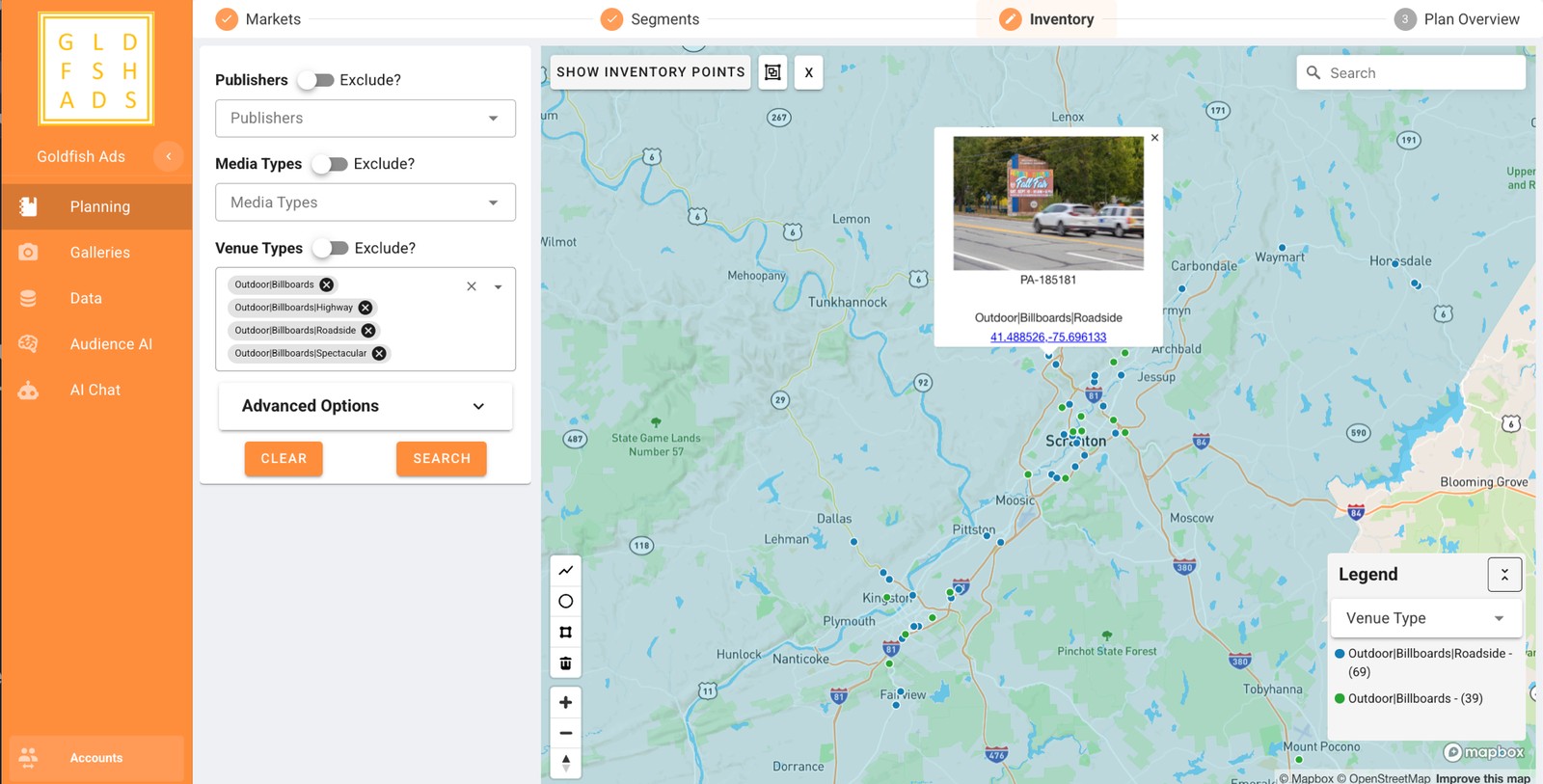
Pick a market, filter to billboards — roadside, highway, or spectacular — and every available digital board drops onto the map, each pin carrying the actual board photo, location, and specs. Build a plan, watch live impressions update, and launch. No RFPs, no chasing a dozen vendors for avails.
View Inventory by City
Buy Billboards & View Inventory in Your City
Pick a market to see live digital billboard inventory, screen counts, audience data, and Street View for that city — then build a plan.
Two Ways to Buy a Digital Billboard in 2026
| Capability | Direct Digital (Publisher Buy) | Programmatic DOOH |
|---|---|---|
| Minimum commit | 4 weeks, rotating slot | Any flight length, start/stop anytime |
| Time to live | 3–7 days | As little as 24 hours |
| Creative changes | Email file, 24h swap | Self-serve, mid-flight |
| Dayparting | Limited | Hour-by-hour |
| Trigger-based creative | Not supported | Weather, sports, traffic, inventory triggers |
| Audience targeting | Face-level, by location | Audience cohorts + 1P/3P data overlays |
| Reporting | Plays log | Play logs, GPS-timestamped photos, lift reads |
| Best for | Single-face brand statement, iconic spectaculars | Multi-market campaigns, performance, conquest |
10 Ways Brands Are Actually Using Billboards Right Now
Geo-conquest competitor stores
Drop a billboard within 1 mile of every competitor location. Drive consideration at the moment of intent.
→ See Kost Tire conquest exampleDaypart by audience rhythm
Run commuter creative 6–9am, lunch promos 11am–2pm, after-work happy hour 4–7pm — all on the same digital face.
→ DOOH dayparting guideTrigger-based creative (weather, sports, traffic)
Swap creative when it rains, when the local team wins, or when traffic backs up — programmatic only.
→ How programmatic triggers workHyperlocal store openings
30-day blitz of every billboard within 5 miles of a new location — a proven traffic-driver for QSR, dispensaries, fitness.
→ Church's Chicken exampleBrand defense around earnings or PR
Buy out billboards in financial districts and HQ markets the week of an earnings call or product launch.
→ Banking & finance DOOHTour, event, and ticket promotion
Geo-target arenas, hotel districts, and rideshare drop zones the week of a show. Bring the line directly to the box office.
→ Event-targeted DOOHRecruiting + employer branding
Highway billboards on the inbound commute lane to your office park. Cheaper and more memorable than LinkedIn ads.
→ Why DOOH beats CTV for B2BPolitical and issue advocacy
DMA-level reach with no platform moderation risk. Heavy spend in cycle years on highway and urban panel inventory.
→ Political DOOH trendsDirect-response with short URL
Works when the creative gives the audience 3 seconds of value — a coupon, a stat, a phone number. Not 'visit our website'.
→ Creative specsAlways-on local brand building
The unsexy use case that pays the bills for most local advertisers — auto dealers, lawyers, urgent care, contractors.
→ All verticalsWho's Actually Spending on Billboards
Per OAAA's 2026 Top 100 OOH Advertisers report, the heaviest billboard spenders span tech, telecom, CPG, legal services, and home services — a mix that reflects DOOH's expansion well beyond traditional retail and entertainment.
The 7-Word Rule and Other Hard Creative Limits
7 words maximum. Highway dwell is 3–7 seconds at 65mph. If your message takes longer than that to read, it doesn't exist. This is the single rule that separates billboards that work from billboards that don't.
One image, one idea, one CTA. Stacking offers ("Buy 1 get 1! Free shipping! New flavors!") destroys recall. Pick one.
Type at least 1/10 the height of the board. Geopath and the OAAA recommend minimum 18" letters for highway boards — anything smaller is unreadable at distance.
Contrast over color theory. White-on-navy and black-on-yellow are the highest-recall combinations in eye-tracking studies. Pastels die in sunlight.
No complex URLs on highway boards. Transit, gyms, bars, and doctors' offices can support a call to action — highway boards at 65mph cannot. Use a memorable URL or short-code instead.
Full specs: DOOH Creative Specs.
Measurement Has Caught Up
The old knock on billboards — "you can't measure them" — is no longer true. Modern DOOH campaigns layer in:
- • Geopath impression measurement — the industry-standard audited audience for every OOH face in the US. geopath.org
- • Device ID exposure → store visit lift via partners like Foursquare, Placer.ai, and AdSquare.
- • Brand lift studies through On Device Research, MFour, and Lucid panels.
- • Web/search lift by comparing exposed vs control DMAs against branded search and direct traffic.
- • Sales attribution via MMM (marketing mix modeling) — OOH typically over-indexes vs digital in MMM rebuilds.
Billboard Advertising FAQ
Common Questions About Billboard Advertising
How much does billboard advertising cost?
Digital billboard advertising is bought on a CPM — cost per thousand impressions — with pricing set in the proposal. You set a budget and it converts directly into impressions across the boards in your plan, so a campaign can start at a few hundred dollars a month or scale to national weight. Traditional static (printed) billboard leases are priced per board per month and vary widely by market and traffic.
How do digital billboards work?
A digital billboard is a large LED screen that displays rotating creative, typically an eight-second slot shared among four to six advertisers. Because the screen is internet-connected, creative can be scheduled by hour, swapped mid-flight, and triggered by conditions like weather, traffic, or a sports score. Digital boards can be bought directly from the operator or programmatically across many boards at once.
What is the difference between a digital billboard and a static billboard?
A static billboard is a printed vinyl that shows one message for the length of the lease, usually four weeks. A digital billboard is an LED screen that rotates multiple advertisers and lets you change creative instantly, daypart by the hour, and buy flights as short as a single day. Digital adds flexibility, faster launch, and audited impression measurement that static cannot match.
Can you target billboards to a specific audience or location?
Yes. Digital billboards can be targeted by geography — ZIP code, county, DMA, a custom map polygon, or a radius around any address — and layered with audience data so delivery weights toward the cohorts you want to reach. That makes it possible to run a single neighborhood, conquest a competitor's locations, or blanket an entire metro from one plan.
How fast can a billboard campaign go live?
Programmatic digital billboard campaigns can go live in as little as 24 hours after creative approval. A direct buy from a single operator usually takes three to seven days. Static printed billboards take longer because the vinyl has to be produced and installed.
How do you measure billboard advertising?
Modern billboard campaigns are measured with audited impression counts from Geopath, aggregate store-visit lift tests, brand-lift survey panels, and search and web lift comparing exposed versus control markets. The old objection that billboards can't be measured no longer holds.
How many words should be on a billboard?
Seven words or fewer for highway boards. Drivers see a billboard for three to seven seconds at speed, so one image, one idea, and one call to action outperform any layout that tries to say more. Slower-dwell environments like transit and gas stations can support a little more copy.
Keep Going
Request Access to Plan Your First DOOH Campaign
Bring an audience and a market — go live in as little as 24 hours.
Contact Us Now